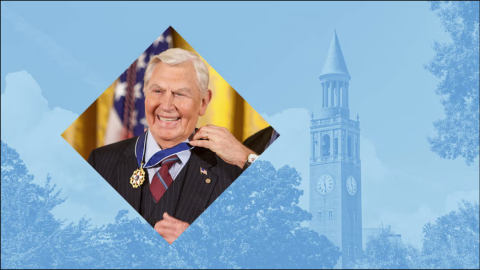
Few entertainers have stayed in the nation’s collective conscience like Andy Griffith ’49. Griffith is best known for his warm and wise television portrayals of Sheriff Andy Taylor and lawyer Ben Matlock.
Griffith began his days as a Carolina student on July 19, 1944.
That day he wrote a letter from his room, “3 Steele Dormitory,” to his parents in Mount Airy, North Carolina. He sounds already enamored with campus life. He mentions a fellow student, a blind boy with a “fine tenor voice” and “a bunch of boys in front of our dormitory singing.” “I think I shall like it here,” he writes.
In August, Griffith sent his parents a postcard featuring Memorial Hall, presaging his first moment on its stage. “I go by this building every day on my way to work,” a reference to his job at Swain Hall, where he bussed tables.
By fall the next year, he was acting on Memorial Hall’s stage in a Carolina Playmakers production of “Gondoliers.”
Griffith described that first performance in a 1978 University Day speech on that same stage. The Carolina Alumni Review’s account by Jim Hughes tells how Griffith moved from a series of jokes that had the scholarly audience laughing to a heartfelt remembrance. “Then, with perfect timing, the jokes stopped and Andy turned serious. ’I want to tell you something,’ he said. The room grew silent.” Griffith said that as he neared the building, “it was all I could do to fight back tears. And the reason was I knew I was going to walk up on this stage, and this is the stage where the first time in my life I was ever in a play.”
As a music major, Griffith played piano, and his bass voice headlined departmental concerts in which he sang classical tunes by composers Verdi and Dalayrac. He starred in Carolina Playmakers productions, was Glee Club president and joined Phi Mu Alpha music fraternity.
After graduation, Griffith taught high school music in Goldsboro, North Carolina, for three years while honing his storytelling and acting skills, notably starring as Sir Walter Raleigh in the long-running production of “The Lost Colony” outdoor drama on Roanoke Island, North Carolina. His 1953 comedy recording “What is Was, Was Football” moved him in big-break fashion to the “Ed Sullivan Show.” He then starred in “No Time for Sergeants” on TV and in the show’s Broadway and movie versions. In the 1957 movie “A Face in the Crowd,” his tour-de-force portrayal of Lonesome Rhodes shows the scope of Griffith’s acting abilities. His movie career includes 2007’s “Waitress.”
His folksy, fatherly manner anchored television’s “The Andy Griffith Show,” set in the fictional North Carolina town of Mayberry. It ran for eight seasons from 1960 to 1968, and re-runs have aired ever since. He had further success on “Matlock” with nine seasons beginning in 1986. One of his last TV appearances was in a 2001 episode of “Dawson’s Creek.”
Griffith sometimes sang and played guitar on “The Andy Griffith Show,” and recorded 16 musical albums, including 1996’s Grammy-winning “I Love to Tell the Story.”
In 1972, Griffith established a scholarship fund in his name for promising dramatic art and music students at Carolina. In 2005, Griffith received the Presidential Medal of Freedom from President George W. Bush, but closer to home, he was one of the first three recipients of the Carolina Performing Arts Lifetime Achievement Awards. That same year, he donated his collection of career memorabilia, including a guitar, to the Southern Historical Collection at Wilson Library.
Griffith died in 2012 at age 86 and was buried on Roanoke Island.